Pages

Showing posts with label garden. Show all posts

Saturday, June 2, 2012

New Garden Beds


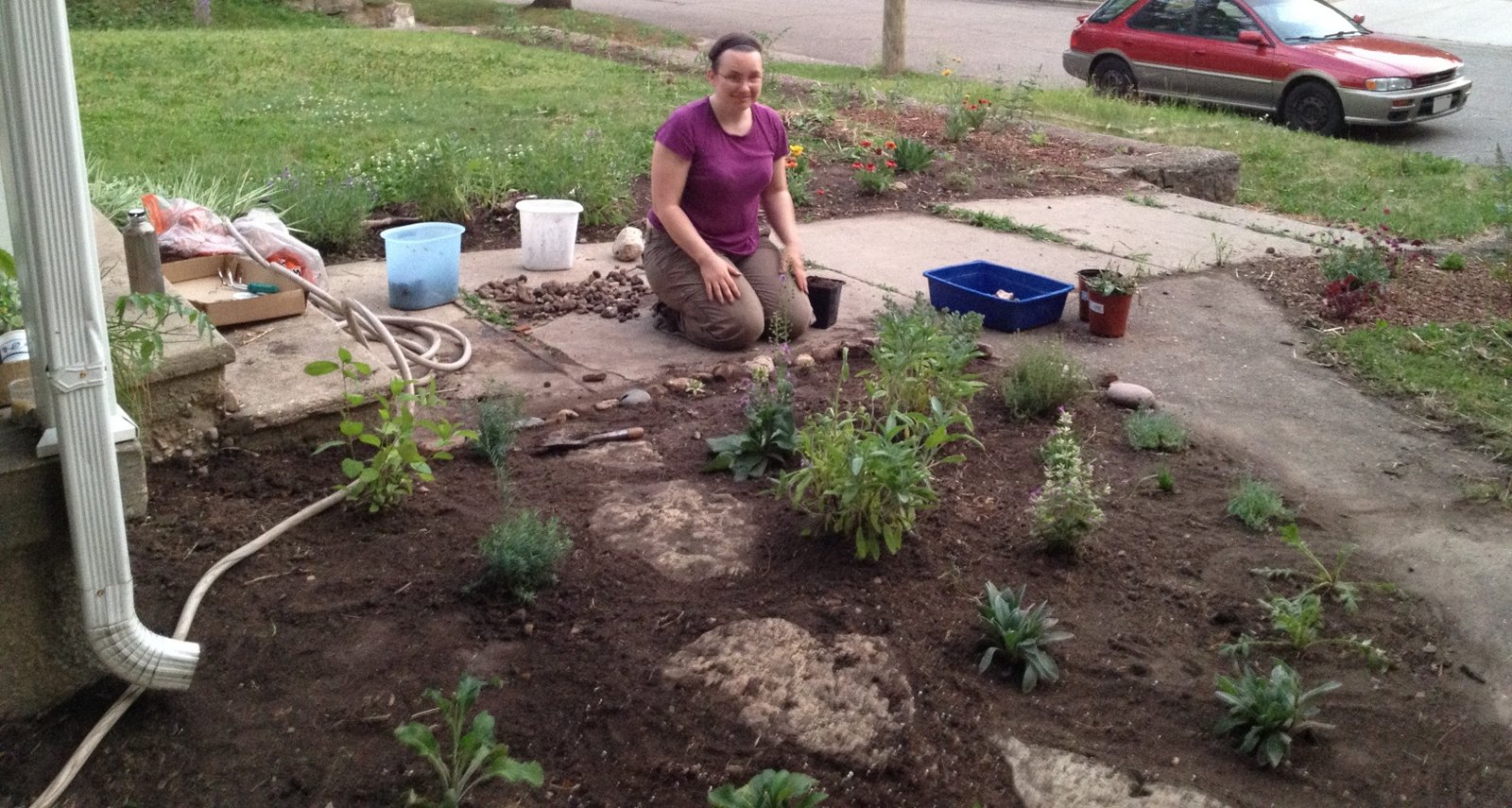
I've been spending a lot of time in the garden, prepping the new beds and then, finally, planting them! This new bed right by the house has been especially successful. I planted perennials that I had dug up from my last place, some from the UW-Arboretum's Native Plant Sale, and others from the fabulous Flower Factory.* For comparison, see these "before" and "after" shots:

Before digging...
...after digging (but before cleaning up)!
I also planted along the front walk and front wall, where there had been either lawn, pampas grass, or old, overgrown perennials:

Tomatoes in a row near the top left; the rest are perennials


*Note: I have not been asked to promote nor do I receive any compensation for mentioning either The Flower Factory or the UW-Arboretum. I do so of own free will, simply because I love both of them and the plants they offer.


Sunday, May 27, 2012

The Duck's Nest: Quackery on Prairie Street

"Our" duck
A week after we moved in, we were pleasantly surprised to find a mama duck nesting in our yard, tucked comfortably into a pile of straw left by the previous owners. And we were thrilled to watch her every day over the next month, counting the eggs while she was away, and then seeing them hatch into fluffy little ducklings!  

Home necessities: air conditioner, meter, duck's nest. 
When I told our next-door neighbors, they were excited, too. They had been seeing a pair of ducks waddling around, nibbling the seed that fell out of their bird feeder. But they didn't realize they were nesting so close.

It seemed like an odd spot at first, but a bit of Googling convinced me otherwise. It turns out that mallards frequently nest near human dwellings in gardens, flowerpots, or vegetation. They will nest up to a couple miles away from water, later leading their brood on a trek to the nearest river or pond. Considering that, we're very close to water (less than 1/4 mile away). Plus, not only is this nest well-shielded by our house and air conditioner, it's also shaded by a big maple tree, meaning that it's safe from overhead predators.

She didn't seem to view *us* as predators. Whenever we walked by, she would just flatten herself against the straw and fix us with a glassy stare.


Beware the stare of a protective mama duck! 

She was gone much of the time, no doubt searching for food, which gave us a chance to take a look at her eggs. While it's difficult to be sure (she covered them pretty well), we think there were up to 6 or 7 eggs total.

Our Duck's eggs

Then, on May 22nd, the ducklings hatched. I glanced at the nest when I got home from work, and noticed some unusual movement, which turned out to be ducklings! As I walked closer, mama duck started ruffling her feathers and hissing at me. She had never done that before! It was clear that no one was getting anywhere close to her babies. 

Mama duck fiercely protecting her ducklings!
I knew that the ducklings could swim right away, and that mama duck would soon lead them to water. But I didn't realize that they would be permanently gone from the nest in under 24 hours. This was too bad, because Junie didn't get a chance to see the ducklings in the nest--if we knew this was the only day to see them, we would have called her Mom's house and had them come over. 

They made it to the water! 

But, as I mentioned, we are very close to water, and on a walk a few days later, we noticed a couple broods of ducklings tagging along behind their mothers. One of these broods had six ducklings, just the right number to be "our" ducks. We decided that they were definitely our duck and her babies. Junie was thrilled to see the babies ("they're so cuuuute!"), and Justin and I were happy to see that they had made it to the water safe and sound. 

I've heard that ducks will nest in the same place year after year. We'll see if she comes back to our garden again next spring!
Saturday, May 26, 2012

Digging new garden beds

Now that everything is grown in enough for me to know what I'm working with,  I'm ready to make the garden my own. That means, of course, digging new beds! This first bed, I dug with very little preparation. I kind of did it on a whim, eager to get my hands in some dirt. It worked out perfectly.

This looks like a perfect spot for a garden bed...

Juniper helps dig up sod (with a shovel as big as she is!)

That's more like it! Now all it needs is some plants.

Next up, along the front sidewalk wall. And this pampas grass has GOT to go. I am not looking forward to all that digging; it has extensive roots that will make it quite the chore. 

Unruly pampas grass.

We rented a tiller to dig the bed along the length of the front wall. To get rid of the pampas grass, I first cut it down with a weed whacker, and then Justin went over the stubble with the tiller. This dug up a lot of the root system, although I still had to go in with a shovel to complete the project. 

Justin tills new beds
See all that brown stuff in that overflowing wheelbarrow? That's ALL stubble and roots from the pampas grass. Phew! I think we got most of it. But any bits we missed will continue to sprout, so I will probably be pulling pampas grass all season. 

New bed along wall, and good riddance to pampas grass!

New bed along other side of wall, and another pile of pampas grass roots. 


Tuesday, May 22, 2012

A Garden in Limbo

Plants waiting for the gardener to get busy

These plants are impatient to get in the ground. Or should I say, I'M impatient to plant them!

Moving in the middle of May, prime planting time, is not ideal for a gardener. But of course, you make do with what you have, and NOT gardening was certainly not an option. So all my houseplants, plus the perennials and vegetables I dug up, grew from seed, or purchased ended up in this makeshift garden holding pen on the side of our house.


It's a veritable jungle of pothos and jade, tomato and basil, liatris and verbena brushing elbows with the native hostas in this semi-shady bed. I used whatever milk crates, wood planks, boxes, and plastic bags I could find to house all these green things. 


Sage, lavender, and sedum dug up from my old garden

Pretty soon, they'll all get in the ground, and hopefully, thrive in their new surroundings. But for now, the challenge is to keep them all alive and well until then!


Sunday, May 20, 2012

What plants can be found in our new yard?

As a gardener eager to have my own yard, it was with great excitement that I examined every inch of our new yard, seeking out recognizable perennial sprouts among weeds. When I found one, it was like a Christmas present: free plants! Already growing in my yard! Of course, what I mostly found was beds choked with weeds, perennials untended for so long as to render them too leggy to bother with, and the ill-advised placement of pampas grass along our front walk.

In the back, there is a small bed with some purple coneflower, black-eyed susans, irises, a sprawling mass of oregano, and a few other herbs. Clearly, this was intended as a kitchen garden.

Herbs and flowers competing against maple seedlings and other weeds

There is also a line of peony bushes...

Peonies on the lot line

Some Shasta daisies...

How can I tell these are daisies? The serrated leaves are a dead giveaway.

A couple of lilac bushes that have seen better days...

Not to mention a wood stove that has seen better days!

Daylilies and yuccas...


An area fenced in with chicken wire, but full of nothing but weeds. 

Perhaps it was a vegetable garden at one point? 


And the aforementioned Pampas grass, growing right along the front walk. There are also some extremely woody lavender plants along the walkway, too. 

Doesn't look so bad yet...but it's only about 1/3 of its full-grown height! 

And a surprise Columbine plant! I also found a surprise Oriental Poppy growing among the Pampas grass. 

A lone Columbine grows next to some hostas
There are also a bunch of hostas on the other side of the house, but you'll just have to take my word for it that they look exactly like ordinary hostas.

Knowing what I have to work with, I can now start to plan what I'm going to plant!